
Educational Document Attestation for UAE In Lahore
Educational Document Attestation for UAE in Lahore is the official process of verifying academic certificates such as matric, intermediate, bachelor’s, master’s, MPhil, PhD, and diploma documents for use in the United Arab Emirates. This process ensures that educational qualifications issued in Pakistan are genuine and legally acceptable in the UAE. It involves verification from the issuing institution, relevant boards or HEC, followed by MOFA Pakistan and UAE Embassy attestation. This attestation is required for jobs, higher education, and immigration purposes in the UAE. It confirms authenticity and makes documents internationally recognized for official use.
Who Needs Educational Document Attestation?
- Job Seekers Applying in UAE
Individuals applying for jobs in the UAE must get their educational documents attested. Employers require verified degrees and certificates to confirm qualifications and eligibility for professional positions.
- Students for Higher Education
Students who want to study in UAE universities or colleges need attested educational documents. It helps admission offices verify the authenticity of previous academic records.
- Skilled and Technical Workers
People applying for technical jobs, such as engineers, technicians, or diploma holders (DAE), must provide attested certificates to meet UAE labor requirements.
- Immigration and Visa Applicants
Applicants applying for family visas, residence visas, or skilled migration programs may need attested educational documents as part of their verification process.
- Professionals for Career Growth
Professionals seeking promotions or better job opportunities in UAE often require attested degrees like Bachelor’s, Master’s, MPhil, or PhD for verification.
- Government and Licensing Authorities
Certain UAE government departments and licensing bodies require attested educational certificates for issuing professional licenses in fields like engineering, teaching, and healthcare.
- Overall Requirement
Anyone planning to work, study, or settle in the UAE with educational qualifications from Pakistan must complete the attestation process to ensure legal acceptance and international recognition.
Documents Required for Educational Document Attestation
- Original Educational Certificates
The most important requirement is the original educational certificate. This can include Matric, Intermediate, Bachelor’s, Master’s, MPhil, PhD, or Diploma of Associate Engineer (DAE). The certificate must be issued by a recognized board, college, or university and should be in good condition without damage or alteration.
- Detailed Mark Sheets / Transcripts
In many cases, detailed mark sheets or transcripts are also required along with the degree or certificate. These documents provide subject-wise academic performance and are often necessary for verification by higher authorities such as HEC or MOFA.
- CNIC Copy of Applicant
A clear copy of the applicant’s Computerized National Identity Card (CNIC) is required for identity verification. It ensures that the educational documents belong to the correct individual during the attestation process.
- Passport Copy
A valid passport copy is often required, especially for UAE attestation. It is used for immigration, visa processing, or employment verification purposes. The passport must be valid and clearly readable.
- Matric and Intermediate Certificates (If Required for Higher Degrees)
For bachelor’s or master’s degree attestation, Matric and Intermediate certificates may also be required by HEC or other authorities to verify the complete academic background of the applicant.
- HEC Attestation Copy (For Higher Education Documents)
For Bachelor’s, Master’s, MPhil, and PhD degrees, attestation from the Higher Education Commission (HEC) is mandatory. Applicants must submit already verified copies or get them verified during the process.
- Authorization Letter (If Using Agent)
If the applicant is using an attestation service provider or agent, an authorization letter is required. This letter allows the agent to submit and collect documents on behalf of the applicant.
- Photographs (If Required)
Some cases may require passport-size photographs, especially for embassy submissions or official record keeping. It is always recommended to keep extra copies available.
- Additional Supporting Documents
Depending on the case, additional documents such as experience letters, equivalence certificates, or board verification letters may also be required for complete attestation.
- Overall Requirement
All documents must be original, accurate, and properly verified before submission. Incomplete or incorrect documentation can cause delays or rejection in MOFA or UAE Embassy attestation. Proper preparation ensures a smooth and successful attestation process for UAE use.
Step-by-Step Process of Educational Document Attestation in Pakistan
Step 1: Verification from Educational Institution
The first step is verification from the issuing institution such as school, college, or university. The original certificate is checked to confirm that it was genuinely issued by the concerned authority.
Step 2: IBCC or HEC Attestation (As Applicable)
For Matric and Intermediate certificates, attestation from IBCC (Inter Board Committee of Chairmen) is required. For Bachelor’s, Master’s, MPhil, and PhD degrees, HEC (Higher Education Commission) attestation is mandatory before further legalization.
Step 3: Notary Public Attestation (If Required)
In some cases, documents are also verified by a Notary Public. This step provides initial legal verification before submitting documents to higher authorities.
Step 4: Ministry of Foreign Affairs (MOFA) Attestation
After completing educational verification, documents are submitted to MOFA Pakistan. MOFA verifies previous stamps and officially attests the documents, making them eligible for international use.
Step 5: UAE Embassy Attestation
Once MOFA attestation is completed, the documents are submitted to the UAE Embassy in Pakistan. The embassy reviews all previous verifications and provides final legalization for use in the UAE.
Step 6: Collection or Courier Delivery
After successful attestation from all required authorities, the documents are returned to the applicant. Many service providers also offer courier delivery for convenience and safety.
Overall Process
This step-by-step process ensures that educational documents are fully verified and legally accepted in the UAE for jobs, higher education, and immigration purposes. Proper sequence and correct documentation are essential for a smooth attestation process without delays.
Fee Structure for Educational Document Attestation in Lahore
The fee structure for Educational Document Attestation in Lahore varies depending on document type and authorities involved. IBCC or HEC attestation usually costs between Rs. 1,000 to Rs. 3,000 per document. MOFA (Ministry of Foreign Affairs) charges are generally around Rs. 1,000 to Rs. 3,000 per certificate. UAE Embassy attestation fees are higher, typically ranging from Rs. 12,000 to Rs. 18,000 depending on exchange rate and document category. If you use an agent or attestation service provider, additional service charges of Rs. 2,000 to Rs. 5,000 may apply. Courier and urgent processing fees may also increase the total cost.
Processing Time for Educational Document Attestation
The processing time for Educational Document Attestation in Pakistan depends on the type of certificate and the authorities involved. Normally, the complete process takes around 5 to 10 working days. IBCC or HEC attestation may take 2 to 5 working days depending on verification requirements. After that, MOFA (Ministry of Foreign Affairs) attestation usually takes 1 to 2 working days. UAE Embassy attestation can take an additional 2 to 4 working days depending on workload and document category. If urgent service or an agent is used, the process may be faster. Proper documentation helps avoid delays and ensures smooth attestation.
Uses of Educational Document Attestation in UAE
- Employment Opportunities in UAE
Educational Document Attestation is mainly required for job applications in the UAE. Employers need verified degrees and certificates to confirm that candidates are genuinely qualified. Without attestation, Pakistani educational documents are not accepted for professional employment. It is especially important for fields like engineering, teaching, healthcare, accounting, and IT where qualifications must be officially verified.
- Higher Education Admissions
Students who wish to study in UAE universities or colleges must submit attested educational documents. Admission offices use these verified certificates to ensure that the student’s previous education is authentic and meets eligibility criteria for advanced studies. Without attestation, universities may reject the application or delay admission.
- Professional Licensing in UAE
Many professions in the UAE require licensing from government authorities such as health departments, engineering councils, or education boards. To obtain these licenses, applicants must provide attested degrees and diplomas. This ensures that only qualified individuals are allowed to practice in regulated professions.
- Immigration and Visa Processing
Educational Document Attestation is also required during immigration and visa processing. Skilled visa categories and family sponsorship cases often require proof of education. Attested certificates help UAE authorities verify the applicant’s qualifications and background.
- Skill-Based Job Categories
For technical and skilled workers such as Diploma of Associate Engineer (DAE) holders, attestation is necessary for employment in construction, mechanical, electrical, and other technical fields. Employers rely on attested documents to ensure technical competency.
- Government and Semi-Government Jobs
Candidates applying for government or semi-government jobs in the UAE must provide attested educational documents. These jobs require strict verification to ensure transparency and authenticity of qualifications.
- Career Advancement and Promotions
Employees already working in the UAE may need attested degrees for promotions or salary increments. Companies often verify higher education credentials before upgrading job positions.
- Equivalency and Certificate Recognition
In some cases, UAE authorities require equivalency certificates based on attested educational documents. This helps in matching foreign qualifications with UAE education standards for official recognition.
- Recruitment Agencies and Job Processing
Recruitment agencies in Pakistan and UAE also require attested documents before forwarding candidates to employers. It ensures that only verified candidates are presented for job opportunities.
- Overall Importance
Educational Document Attestation plays a vital role in ensuring that academic qualifications are recognized and accepted in the UAE. It supports employment, education, licensing, immigration, and career growth. Without proper attestation, educational documents have no legal value in UAE institutions, making it an essential process for anyone planning to work or study in the country.
Common Mistakes to Avoid in Attestation Process
- Submitting Incomplete Documents
One of the most frequent mistakes applicants make is submitting incomplete documents. For Educational Document Attestation, all required papers such as original certificates, mark sheets, CNIC copy, and passport copy must be provided. Missing even a single document can cause delays or rejection at IBCC, HEC, MOFA, or UAE Embassy levels.
- Using Unverified Educational Certificates
Another serious mistake is using documents that are not properly verified from the issuing institution. If the certificate is fake, altered, or not issued by a recognized board or university, it will be rejected immediately during the attestation process. Always ensure your documents are original and officially issued.
- Skipping IBCC or HEC Verification
Many applicants try to directly submit documents for MOFA attestation without completing IBCC (for matric/intermediate) or HEC (for degrees) verification. This is not acceptable and results in rejection. These steps are mandatory before proceeding to higher authorities.
- Incorrect Personal Information
Errors in name spelling, father’s name, CNIC number, or date of birth are very common. Even small mistakes can cause major issues during attestation or visa processing in the UAE. All details must exactly match official records.
- Not Following Proper Attestation Sequence
The attestation process must follow a fixed order: Educational Board/HEC → MOFA Pakistan → UAE Embassy. Changing or skipping steps leads to rejection and unnecessary delays.
- Using Unreliable Agents
Many people choose cheap or untrusted agents who may mishandle documents or provide incorrect guidance. This can result in document loss, delays, or financial loss. Always choose a professional and authorized attestation service provider.
- Ignoring Processing Time
Some applicants expect instant results and fail to consider the required processing time for each authority. Rushing the process without proper planning often leads to stress and delays.
- Not Checking Updated Embassy Requirements
UAE Embassy requirements may change over time. Not checking the latest rules before submission can lead to rejection. It is important to stay updated with current attestation policies.
- Poor Document Handling
Folding, damaging, or laminating original documents before attestation can create issues during verification. Documents should always be kept clean, original, and in proper condition.
- Incorrect Photocopies or Scans
Submitting unclear or unreadable copies can delay the process. All photocopies must be clear, properly scanned, and match the original documents exactly.
- Overall Advice
Avoiding these common mistakes ensures a smooth and successful Educational Document Attestation process. Proper preparation, correct documentation, and following the legal procedure step-by-step are essential for quick approval and acceptance in the UAE for jobs, studies, and immigration purposes.
How to Verify Attested Educational Documents
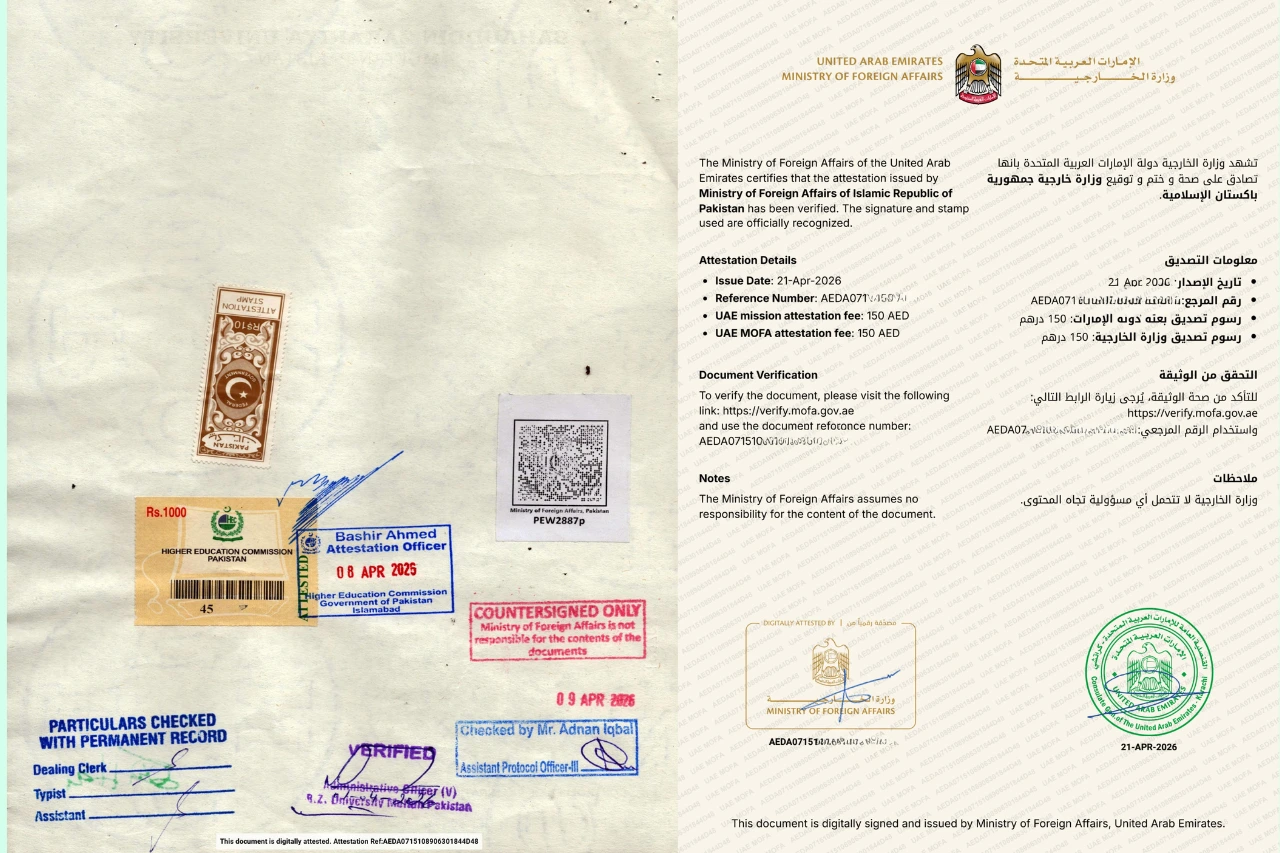
Attested educational documents can be verified by checking the stamps and seals of all relevant authorities, including the issuing institution, IBCC or HEC, MOFA Pakistan, and the UAE Embassy. Each stamp should be clear, official, and properly placed on the document. You can also verify MOFA attestation through the official MOFA verification system or by visiting their office. UAE Embassy attestation may be confirmed through serial numbers, barcodes, or embassy records if available. Always ensure that the document details match the original records exactly. Proper verification confirms authenticity and ensures acceptance in the UAE for jobs, studies, and immigration.
It is the process of verifying educational certificates so they become legally valid for use in the UAE for jobs, studies, and immigration purposes.
Matric, Intermediate, Bachelor’s, Master’s, MPhil, PhD, and Diploma of Associate Engineer (DAE) documents can be attested for UAE use.
UAE Embassy attestation confirms that Pakistani educational documents are genuine and officially accepted in the UAE.
The complete process usually takes around 5 to 10 working days depending on document type and verification requirements.
Yes, HEC attestation is mandatory for Bachelor’s, Master’s, MPhil, and PhD degrees before MOFA and UAE Embassy attestation.
You usually need original educational certificates, transcripts, CNIC copy, passport copy, and supporting documents if required.
Yes, attested educational documents are commonly required for employment, professional licensing, higher education, and visa processing in the UAE.